Rain Harvesting


  Rain Harvesting  


Harvest Greywater or Rainwater?

By John Bauer, Wahaso President

We find that there is a lot of confusion out there about greywater, (also called gray water and graywater), and rainwater usage. Which system is the best for a particular use? The usual assumption is that a greywater system, which must filter and sanitize water from showers and sinks, will be more expensive than a rainwater system. This may or may not be true, depending on your situation.

Generally, we find that a rainwater system makes the most sense when the following conditions apply for a property:

  • The building is already existing, so it is economically unfeasible to separate the existing waste streams from the toilet, showers and sinks to capture greywater.
  • The water use requires a very clean source with little dissolved solids – for cooling tower make-up, washer rinse or vehicle washing.
  • There is an abundant source of rainwater in the area so that the storage size can be minimized.

Greywater systems are often a better choice when these conditions exist:

  • The building houses residents, so there is ample supply of greywater from showers and sinks.
  • The primary uses of the harvested water will be toilet flushing and irrigation.  Greywater is an excellent source for these uses.
  • The building plumbing has not yet been completed so there is time to change the layout to capture shower and sink water separately from the toilet black water.
  • The property is located in an arid part of the country that gets little or very seasonal rainfall.

If greywater is an option for your property – that’s good news.  Unlike rainwater supply that is highly dependent on local  rain events, greywater is a very reliable source, tied directly to building usage.  Residents flushing toilets are also showering and washing their hands.

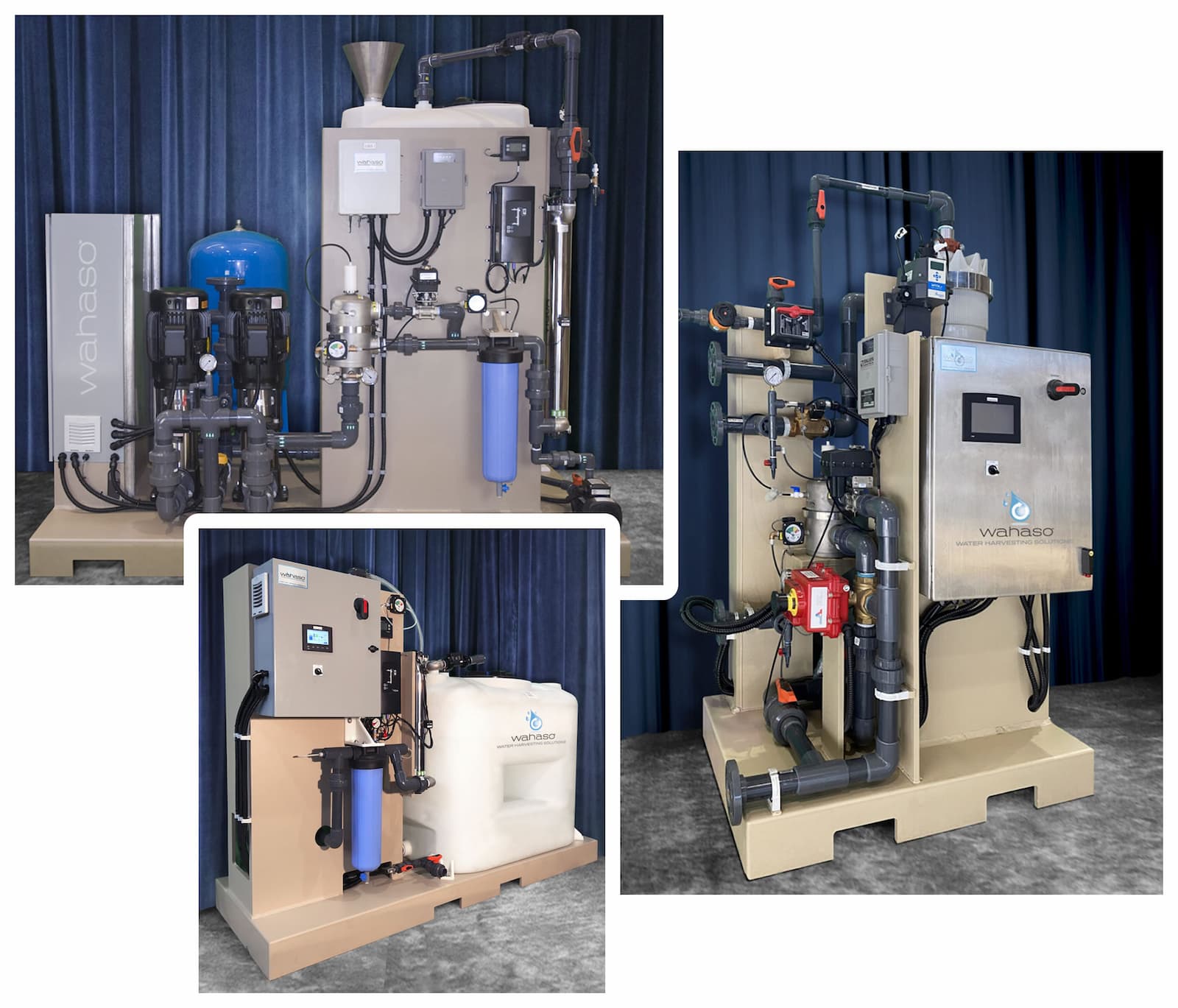
And while a greywater processing skid is somewhat more expensive than a rainwater system, the reliable source of greywater means that we usually only need to store a few hundred gallons of processed water at a time.  That saves a tremendous amount of the cost and space requirements associated with a large rainwater system. A typical commercial rainwater system can require tens of thousands of gallons of cistern storage.

The net result is that a greywater system can predictably save  more municipal water for a lower total system cost than a rainwater system.  The one caveat here is the added cost of running a separate waste line in a building to capture the greywater for harvesting.  Depending on the plumbing layout for a building, this cost can be relatively insignificant or a sizable investment.

And we should note that a greywater system will need a bit more maintenance than a simple rainwater system.  Greywater sanitation requires the addition of chlorine, and there is additional filter maintenance.  But these maintenance needs are typical of the many systems in a commercial building and require no special skills or training.

Our best advice about whether rainwater or greywater harvesting is right for you is to have you talk with us at Wahaso.  We can help you evaluate the feasibility and cost considerations for both options as they relate to your unique building.  Please contact Wahaso.  And you can learn more about greywater harvesting and rainwater harvesting by visiting our website.


Add Water Harvesting to Your LEED Project to Achieve Gold & Platinum Levels

Many of our projects at Water Harvesting Solutions involve clients who are pursuing Leadership in Energy and Environmental Design (LEED) certification.  This program, developed by the U.S. Green Building Council, provides an independent, third party evaluation of a building to determine if it meets optimum performance in five areas:

  1. Sustainable site development
  2. Water savings
  3. Energy efficiency
  4. Material selection
  5. Environmental quality

Each performance area is assigned a set number of points which are accrued through meeting various criteria.  These points are added up to determine if the building has achieved LEED certification.  To certify a new building as “green” requires 40-49 points. More points are required to achieve the higher certification levels of Silver (50-59 points), Gold (60-79 points) and Platinum (80 points or more).  Those higher certification levels almost certainly must include achievements in categories related to water conservation.

The water efficiency goals of the LEED program encourage smart water use both inside and outside of the building and can provide up to 12 possible points toward certification.  In the area of Water Savings points can be accumulated in the following categories: 1) water efficient landscaping, 2) innovative wastewater technology and 3) water use reduction.

Harvested water can be a key component to obtaining LEED water savings points.  For example, using captured rainwater or greywater for irrigation can provide points for the “water efficient landscaping” category.  A 50% reduction of potable water for landscaping is worth two LEED points and a 100% reduction is worth four points.   Water harvesting can also be used to gain two points in the “innovative wastewater technology” category.  Reusing rainwater and greywater not only helps to reduce potable water consumption, but it also reduces the amount of water sent into the municipal storm system.  Finally, up to four points can be awarded for overall water use reduction (irrigation is not included since it has a dedicated category.)  A baseline for water usage is calculated for the building and the amount of points received corresponds to the amount of water saved:

  • 30% reduction from baseline = two points
  • 35% reduction from baseline = three points
  • 40% reduction from baseline = four points

Additionally, water harvesting can earn points in the area of Sustainable Site Development.  Harvesting stormwater for reuse can earn one point for minimizing run-off and one point for reducing the amount of contaminants that enter the storm system.

Our most efficient systems often capture multiple sources of on-site water for multiple uses.  So a single system might capture rainwater, greywater and condensate to flush toilets and irrigate landscaping, saving as much as 90% of the total municipal water an office building would otherwise use.  These systems can earn points from all four categories and help boost a project into the Gold or Platinum point levels.

The benefits of LEED certification are both environmental and financial.  Not only does reducing water consumption help to conserve a vital resource, but it also reduces costs for municipal water use and stormwater management.  LEED certification is also shown to increase a property’s resale value, making the investment in a water harvesting system a winning proposition.

Kim Seay

Marketing Manager

Funding Resources for Water Harvesting Systems

Clients often ask us about resources for funding our harvesting systems for their projects. While conserving water through the use of harvesting systems is a great idea, the reality of installing large commercial systems can be costly.  We’re happy to report that we are beginning to see some options out there that can help defray some – or all of the costs for a system. We see three good sources for funding: 1) grants, 2) loan programs and 3) stormwater fee discounts. 

The first incentive, grants, has not been a common funding tool in the past.  However, grants are becoming more available as the importance of water conservation is growing.  Grants can be offered through government programs such as the San Francisco Public Utilities Commission’s Urban Watershed Stewardship Grant.  The city of San Francisco recognized that in providing assistance, they were helping with the city’s overall stormwater management.  New York’s Green Infrastructure Grant Program also helps to abate stormwater issues by providing funding to property owners, businesses and non-profits for rainwater harvesting, green roofs, rain gardens and bioswales.  Grants can also be found through local community groups and private sources such as the One Percent Foundation.

Loans are also available for many sustainability projects, including water harvesting, through a variety of sources.  One source is the Environmental Protection Agency’s (EPA’s) Clean Water State Revolving Fund.  This program provides loans for both large and small projects and while it has not traditionally been used for water harvesting, the number of green infrastructure projects is increasing.  It is important to note that the EPA limits use to capital costs such as cisterns.  Visit the EPA’s web site for more information on how to manage stormwater with green infrastructure.

Finally, when looking for financial incentives to install a water harvesting system, it can be beneficial to investigate if discounts are available for municipal stormwater fees.  For example, the city of Portland, Oregon has the “Clean River Rewards” program.  Customers who actively manage their stormwater runoff using methods such as rainwater harvesting, are eligible for a discount of up to 100% on their municipal stormwater charges.  Similar to the theory behind the New York and San Francisco grants, the discounts encourage stormwater management by the property owners and lessen the impact on the community’s storm system.

Investing in a water harvesting system may seem expensive, but there are funding options available.  It’s also important to remember that these systems have the potential to save hundreds of thousands of gallons of municipal water each year, saving real dollars of operating costs for the life of a building.  And the USGBC has determined that a LEED certified building, with its lower operating costs and “green” credentials, can demand a market price of about 15% more than a similar non-LEED building, so the investment is worthwhile for the property owner and the environment.  For more information on funding resources and other sustainability topics, visit the Wahaso web site.

Kim Seay

Wahaso Marketing Manager

Are You Getting Soaked By Rising Water Rates?

Chicago and its surrounding suburbs are bracing for the inevitable – much higher rates for the drinking water that too many of us take for granted and as limitless. Those rates are expected to double in the next three years, and our first reaction may be to cry “Foul!” But the truth is, we have all been undercharged for our municipal water for decades because the cost of the infrastructure to deliver that water (now and in the future) far exceeds the rates we have been paying.  If our municipalities are to continue supplying us with all the water we need, we are going to have to expect to pay more for the service.

With regard to those higher rates, most of us can probably neutralize the cost increase just by making minor changes in the way we use water.  It could be as simple as turning off the water between swipes of our toothbrushes and razors as we rinse, taking slightly shorter showers and adding a timer to our irrigation hoses. Eric Zorn, columnist for the Chicago Tribune, offered a similar argument in his November 16 article, “Getting Soaked? Doing the math on the new water plan.” I liken the current situation to a world where gasoline is essentially free and limitless and we leave the engine running all night because it is easier than turning the ignition on and off.  As soon as the gas has a real cost to us per gallon, we’ll make a number of changes quickly to reduce our use – and cost – of the resource.

Avoid being soaked by higher water rates by reducing your usage

Of course, Wahaso is in the business of helping folks reduce their costs for municipal water through rainwater harvesting, greywater harvesting and other strategies to reuse water available onsite for non-potable uses like toilet flushing, irrigation and cooling tower make-up.  By all means, make the simple changes first that can reduce the amount of municipal water your family of facility uses.  Then change out the toilets and shower heads and faucet heads to reduce the gallons per use. And when you are ready to replace that municipal water being used for non-potable purposes through water harvesting, contact us!  Then you can look smug when the rising municipal water rates pay back the cost of your system in half the time.